
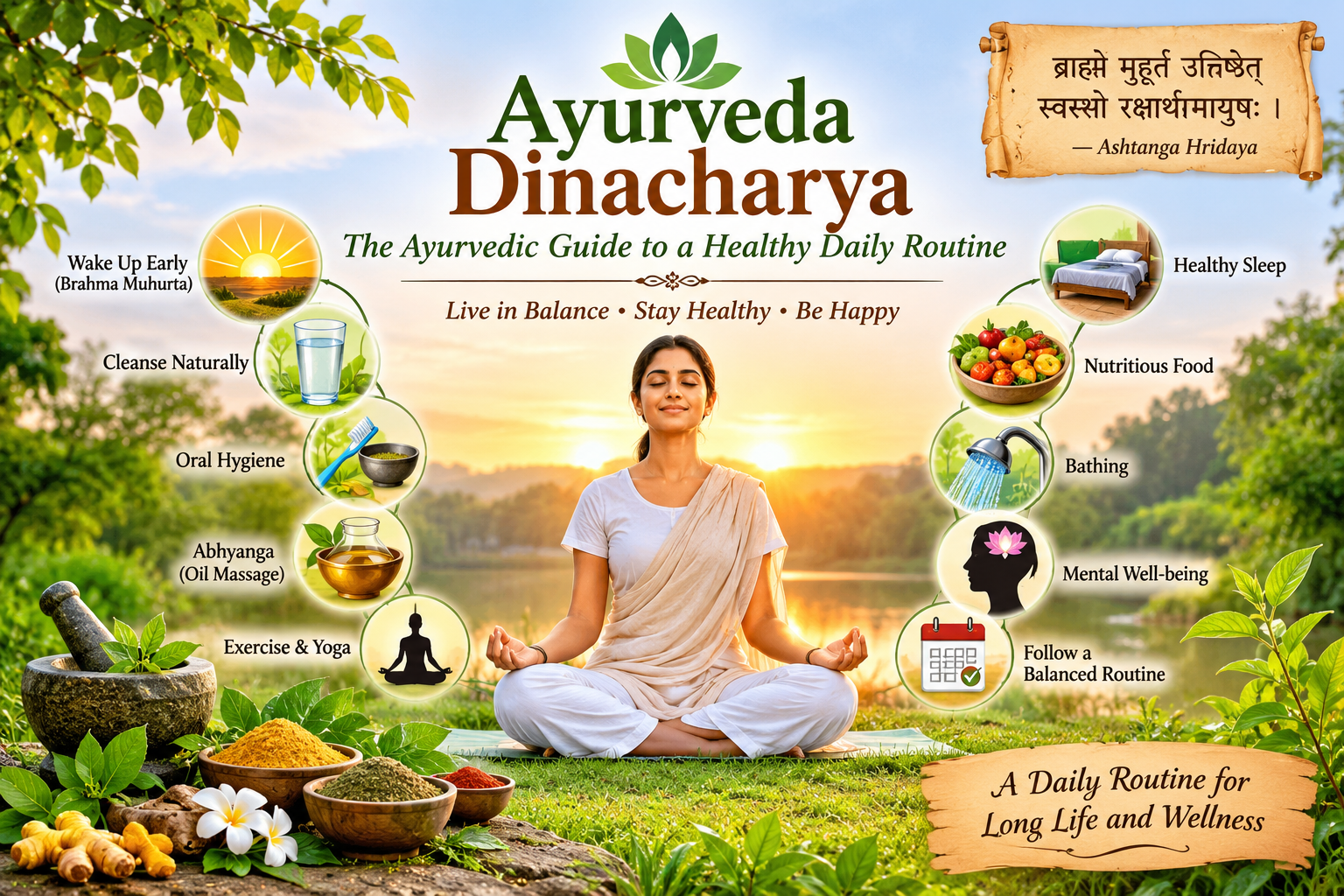
By Dr.Thiron Kumarasinghe
A traditional approach to maintaining physical, mental and spiritual well-being
Understanding the Ayurvedic daily routine from waking up at sunrise to a peaceful night's sleep
1. Introduction: What is Dinacharya?
Dinacharya (दिनचर्या) is the Ayurvedic concept of a daily routine designed to support health, maintain physiological balance and promote harmony between the individual and the natural environment.
The Sanskrit word consists of two parts:
Dina (दिन): Day.
Charya (चर्या): Conduct, behaviour or routine.
Dinacharya therefore refers to the daily practices and lifestyle habits recommended by Ayurveda.
Ayurveda considers health to be more than simply the absence of disease. It involves a balanced state of the Doshas, proper functioning of the Dhatus (body tissues), balanced Agni (digesctive and metabolic activity), appropriate elimination of waste products, and a healthy state of the mind and senses.
The classical Ayurvedic approach places particular importance on three interconnected lifestyle principles:
Dinacharya: Daily routine.
Ritucharya: Seasonal routine.
Sadvritta: Healthy personal, social and ethical conduct.
The purpose of Dinacharya is to establish regular habits that support the body's natural daily rhythms.
It is described particularly in the daily regimen chapters of Ashtanga Hridaya and in Charaka Samhita, Sutrasthana, Chapter 5.
Importantly, Ayurveda does not recommend exactly the same routine for everyone. Individual constitution (Prakriti), current Dosha imbalance (Vikriti), age, physical strength, digestive capacity, occupation, climate and health conditions should all be considered.
2. The Ayurvedic understanding of the biological clock
Ayurveda describes the day and night through the influence of the three Doshas: Vata, Pitta and Kapha.
Traditionally, each Dosha is associated with two periods of approximately four hours.
Time Dominant Dosha Traditional characteristics 6 AM–10 AM Kapha Stability, heaviness and strength 10 AM–2 PM Pitta Digestion, transformation and metabolism 2 PM–6 PM Vata Movement, communication and activity 6 PM–10 PM Kapha Relaxation and preparation for sleep 10 PM–2 AM Pitta Internal metabolic and transformative processes 2 AM–6 AM Vata Movement, elimination and mental activity
These are traditional Ayurvedic time associations, not experimentally established measurements of circulating Dosha levels.
They offer a useful framework for understanding why Ayurveda emphasizes regular waking, daytime activity, appropriately timed meals and early sleep.
3. Complete Ayurvedic morning routine (Pratahkal Dinacharya)
3.1 Brahma Muhurta: Waking up before sunrise
Traditional time: Approximately 96 minutes before sunrise.
Brahma Muhurta is considered an auspicious period for waking, meditation, learning and spiritual practices.
In classical Ayurveda, waking during this period is recommended for healthy individuals.
Why is it recommended?
Provides quiet time for self-awareness and reflection.
Creates an opportunity for meditation and breathing exercises.
Encourages a consistent daily routine.
Allows sufficient time for personal hygiene and physical activity.
Supports a regular sleep-wake schedule.
Modern perspective:
A consistent waking time and sufficient sleep are more important than forcing yourself to wake at an extremely early hour.
Most adults need at least seven hours of sleep. Therefore, waking before sunrise should be accompanied by an appropriately early bedtime.
Practical recommendation:
Aim to wake between 5:00 and 6:00 AM, adjusting according to sunrise, occupation and individual sleep requirements.
People with sleep deprivation, illness, pregnancy or demanding physical schedules should not sacrifice adequate sleep to follow Brahma Muhurta.
3.2 Pratah Smarana: Positive thoughts upon waking
Ayurveda and traditional Indian culture recommend beginning the day with positive thoughts, gratitude, prayer or spiritual reflection.
This practice encourages a calm and constructive mental state.
Suggested activities:
Express gratitude.
Set positive intentions for the day.
Spend a few minutes in silence.
Practise prayer or meditation according to personal beliefs.
Avoid immediately checking stressful messages and social media.
The purpose is to begin the day with awareness rather than unnecessary mental stimulation.
3.3 Ushapana: Drinking water in the morning
Ushapana refers to drinking water in the morning.
Traditional Ayurvedic practices often recommend drinking water after waking, sometimes in a copper vessel.
Traditional purpose:
Support normal bowel movements.
Rehydrate the body after overnight sleep.
Establish a regular morning routine.
Encourage normal digestive and elimination functions.
How to practise:
Drink a comfortable amount of clean drinking water.
Room-temperature or mildly warm water may be used.
Avoid forcing large quantities of water.
Adjust intake according to thirst, climate and medical requirements.
There is no established scientific requirement to drink a fixed number of glasses immediately after waking.
Important: People with heart failure, advanced kidney disease or medically prescribed fluid restrictions should follow their healthcare professional's advice.
Copper vessels are traditional, but there is insufficient evidence that drinking water from copper containers provides special detoxification or immunity benefits. Excessive copper exposure can be harmful.
3.4 Malamutra Visarjana: Natural elimination
Malam means faeces, and Mutra means urine.
Visarjana refers to elimination.
Ayurveda emphasizes responding appropriately to natural bodily urges rather than unnecessarily suppressing them.
Morning elimination is a common component of traditional Dinacharya.
Ayurvedic understanding:
Regular elimination is important for maintaining the proper movement of Vata and the removal of bodily waste products.
Practical recommendations:
Respond to the natural urge to defecate.
Establish a regular toilet routine.
Avoid excessive straining.
Maintain adequate hydration.
Include sufficient dietary fibre.
Remain physically active.
Avoid routinely postponing urination.
A bowel movement immediately after waking is not compulsory for every healthy person.
Persistent constipation, blood in the stool, unexplained weight loss or a sudden change in bowel habits requires medical assessment.
4. Oral hygiene: Dantadhavana and Jihwa Nirlekhana
Oral hygiene is an important component of Dinacharya.
Classical Ayurveda describes several procedures for maintaining oral cleanliness.
4.1 Dantadhavana: Cleaning the teeth
Dantadhavana means cleansing the teeth.
Traditional Ayurvedic texts describe using herbal chewing sticks known as Dantakashta.
Traditionally recommended plants include certain bitter, astringent and pungent-tasting species.
The choice of plant depends on the traditional indications and suitability of the individual.
Traditional purpose:
Clean the teeth.
Maintain oral freshness.
Support healthy gums.
Remove food particles and deposits.
Modern practical method:
Use a soft-bristled toothbrush.
Brush for approximately two minutes.
Brush twice daily.
Use fluoride toothpaste.
Clean all tooth surfaces gently.
Visit a dentist regularly.
Herbal chewing sticks should never replace established dental hygiene or appropriate dental treatment.
4.2 Jihwa Nirlekhana: Tongue cleaning
Jihwa means tongue, and Nirlekhana means scraping or cleansing.
Tongue cleaning is traditionally recommended to remove accumulated deposits from the tongue.
Method:
Use a clean tongue scraper.
Gently place it towards the back of the tongue, only as far as comfortable.
Move it forward.
Repeat gently a few times.
Rinse the mouth and clean the scraper.
Avoid aggressive scraping, which may cause irritation or injury.
Persistent white patches, ulcers, bleeding or unusual changes in the tongue should be examined by a healthcare professional.
4.3 Mukha Prakshalana: Washing the face and mouth
Mukha means face, and Prakshalana means washing.
Wash the face and mouth with clean water.
This helps remove accumulated sweat, oil and environmental impurities.
Use comfortable-temperature water and avoid harsh cleansers, especially on sensitive skin.
5. Gandusha and Kavala: Traditional oil pulling and gargling
These are two different oral procedures described in Ayurveda.
5.1 Gandusha
Gandusha refers to holding a sufficient quantity of liquid in the mouth without actively moving it around.
Traditionally, sesame oil is among the substances used.
Traditional Ayurvedic benefits:
Supports oral cleanliness.
Helps maintain comfort in the mouth.
Traditionally recommended for oral and throat care.
Traditional method:
Take an appropriate amount of suitable oil.
Hold it gently inside the mouth.
Avoid swallowing it.
Spit it into a waste container.
Rinse the mouth.
There is no requirement to hold oil in the mouth for an excessively long period.
5.2 Kavala
Kavala involves holding a smaller quantity of liquid in the mouth and moving it around or gargling.
Traditional liquids include oil and suitable herbal preparations.
Important scientific distinction:
Some small studies suggest oil pulling may improve certain oral hygiene measures. However, evidence remains limited, and it has not been established as a treatment for dental disease or systemic illnesses.
Oil pulling must not replace brushing with fluoride toothpaste, flossing or dental treatment.
Avoid the practice if you have difficulty swallowing or a significant risk of aspiration.
6. Nasya: Traditional nasal care
Nasya is an Ayurvedic procedure involving the administration of selected substances through the nasal passages.
It is described in classical Ayurvedic literature as an important practice for the care of the head and sensory organs.
Pratimarsha Nasya
Pratimarsha Nasya is a milder form of Nasya traditionally described for regular use.
Selected oils, including suitable sesame-based preparations, are traditionally used.
Traditional Ayurvedic understanding:
Nasya is associated with the care of the nasal passages, head and sensory organs.
Important safety information:
Nasal oil administration is not suitable for everyone.
Oil entering the lungs can cause a rare but serious condition called exogenous lipoid pneumonia.
Therefore:
Never force oil into the nose.
Avoid self-administering large quantities.
Do not use nasal oil during active nasal infection or significant congestion without professional advice.
People with swallowing difficulties or aspiration risks should avoid it.
Seek advice from a qualified practitioner before beginning regular nasal oil treatment.
Modern evidence does not establish that routine Nasya prevents neurological disease, improves memory or treats sinus disease.
7. Anjana: Traditional eye care
Anjana refers to the application of selected preparations to the eyes.
Classical Ayurveda describes different forms of Anjana for specific indications.
Traditional preparations include certain collyrium and herbal formulations.
However, the eyes are particularly sensitive organs.
Modern safety recommendation:
Do not put homemade herbal mixtures, unsterile oils, powders or non-ophthalmic preparations into the eyes.
Use only products manufactured and approved for ophthalmic use.
People with eye irritation, infection, glaucoma or other eye disorders should seek advice from an eye-care professional.
Routine application of traditional collyrium is not necessary for healthy eyes.
8. Dhumapana: Traditional medicated smoke
Dhumapana is described in classical Ayurveda as the inhalation of specific medicated smoke preparations.
Historically, it was used for selected indications involving the head and respiratory passages.
However, this traditional practice should not be confused with modern respiratory health recommendations.
Important modern precaution:
Inhaling smoke can irritate the respiratory tract and may aggravate asthma, bronchitis and other respiratory conditions.
Routine smoke inhalation is not recommended as a general wellness practice.
Non-smoke alternatives, such as appropriate breathing exercises, are preferable for general daily wellness.
9. Abhyanga: Ayurvedic oil massage
Abhyanga is one of the most widely recognized practices in Ayurveda.
It refers to the application of oil over the body with appropriate massage techniques.
Classical Ayurveda particularly recommends Abhyanga for maintaining skin health and supporting physical comfort.
Traditional benefits
Nourishment and conditioning of the skin.
Maintenance of skin softness.
Supporting relaxation.
Promoting a sense of physical comfort.
Traditionally associated with supporting sleep.
Traditionally recommended for Vata pacification.
Commonly used oils
Oil Traditional Ayurvedic association Sesame oil (Tila Taila) Commonly used for Vata-oriented care Coconut oil (Narikela Taila) Traditionally used for cooling and skin care Castor oil (Eranda Taila) Used in selected therapeutic preparations Bala Taila Traditional oil preparation used for specific indications Dhanwantharam Taila Traditional Ayurvedic medicated oil Mahanarayana Taila Traditionally used for musculoskeletal care
The choice of oil should depend on the person's constitution, skin condition, climate and therapeutic requirements.
How to practise daily Abhyanga
Select a suitable oil.
Warm it gently to a comfortable temperature, if appropriate.
Apply a small quantity to the body.
Use gentle, comfortable strokes.
Massage the arms and legs.
Use circular movements over the joints.
Apply gentle massage to the abdomen and chest.
Pay attention to the feet.
Allow the oil to remain on the skin for a short comfortable period.
Wash with a suitable mild cleanser if needed.
Avoid vigorous massage over injured, inflamed or infected skin.
People with reduced sensation, bleeding disorders, fragile skin or certain medical conditions should seek professional advice.
How often?
Traditional Ayurveda recommends regular Abhyanga, but daily full-body massage is not essential for everyone.
A shorter daily self-massage or a few sessions each week may be more practical.
10. Shiro Abhyanga: Head massage
Shiro means head, and Abhyanga means oil massage.
Shiro Abhyanga is the traditional application of suitable oil to the scalp and head.
Traditional Ayurvedic literature associates head oiling with hair and scalp care, relaxation and sensory well-being.
Common traditional oils include:
Brahmi Taila.
Neelibhringadi Taila.
Suitable sesame-based preparations.
Practical method:
Apply a small amount of suitable oil.
Massage the scalp gently with fingertips.
Avoid excessive pressure.
Wash when necessary.
There is insufficient clinical evidence to claim that regular oil massage prevents hair loss or reverses baldness.
11. Padabhyanga: Foot massage
Pada means foot.
Padabhyanga is the traditional oil massage of the feet.
It is traditionally associated with relaxation, nourishment of the feet and support for restful sleep.
Method:
Clean and dry the feet.
Apply a small quantity of suitable oil.
Massage the soles gently.
Massage the heels and toes.
Avoid slippery surfaces when standing afterwards.
People with diabetes, neuropathy, foot ulcers or impaired circulation should take particular care and seek professional guidance before massage.
12. Vyayama: Physical exercise
Vyayama means physical exercise or purposeful physical activity.
Ayurveda considers appropriate exercise important for maintaining physical strength and functional capacity.
Classical texts emphasize that exercise should be adapted to the individual's strength, age, health condition and season.
Traditional Ayurvedic benefits
Supporting physical strength.
Improving functional capacity.
Maintaining body composition.
Supporting digestive activity.
Promoting physical endurance.
Traditionally associated with reducing excessive Kapha.
Suitable daily activities
Walking.
Yoga.
Swimming.
Cycling.
Strength training.
Gentle stretching.
Traditional physical exercises.
How much exercise?
For a healthy adult, modern WHO recommendations are:
150–300 minutes of moderate-intensity aerobic activity per week, or an equivalent combination of moderate and vigorous activity.
Muscle-strengthening exercises on at least two days per week.
The Ayurvedic principle of Ardha Shakti
Ardha Shakti refers to exercising up to approximately half of one's available physical capacity.
This is a traditional Ayurvedic principle of moderation, rather than a scientifically validated universal exercise intensity formula.
Exercise should be stopped if there is chest pain, dizziness, unusual breathlessness or significant discomfort.
People with existing medical conditions should choose an appropriate exercise programme.
13. Udvartana: Herbal powder massage
Udvartana is a traditional Ayurvedic procedure involving the application and rubbing of selected herbal powders over the body.
It is generally performed using dry powders or suitable prepared mixtures.
Traditional purposes include:
Skin cleansing.
Supporting skin texture.
Traditionally reducing excessive Kapha.
Improving the feeling of lightness.
Supporting traditional body-care programmes.
Method
Select an appropriate herbal powder.
Apply it to suitable areas of the body.
Rub gently using the prescribed direction and technique.
Remove the powder after the treatment.
The intensity and duration depend on the preparation and individual suitability.
Avoid aggressive rubbing, particularly on dry, sensitive, inflamed or damaged skin.
Udvartana should not be advertised as a scientifically established method for eliminating body fat or treating obesity.
14. Snana: Bathing
Snana means bathing.
Bathing is an important part of traditional daily hygiene.
Ayurveda recommends bathing in a manner suitable for the individual, season and health condition.
Traditional considerations:
Bathing supports cleanliness and freshness.
It is traditionally associated with improving comfort and alertness.
Appropriate bathing is considered part of personal hygiene.
Practical recommendations
Use clean water.
Select a comfortable water temperature.
Avoid excessively hot water.
Use mild cleansers.
Dry the body properly.
Wear clean clothing.
After oil massage, a comfortable warm shower may be used.
Avoid very hot water over the head, especially if it causes discomfort.
People with certain cardiovascular conditions, dizziness or heat intolerance should take additional precautions.
15. Dressing and personal grooming
After bathing, Ayurveda recommends wearing clean and appropriate clothing.
Traditional texts also discuss personal grooming, perfumes, ornaments and cleanliness.
Modern recommendations include:
Wear clean, breathable clothing.
Maintain skin and hair hygiene.
Use appropriate sun protection.
Keep nails clean.
Avoid excessive use of fragranced products if the skin is sensitive.
Maintain good personal hygiene.
16. Yoga, Pranayama and meditation
Yoga and mental discipline are important components of a balanced Ayurvedic lifestyle.
16.1 Asana
Asana refers to physical postures.
Regular appropriate Yoga practice can support:
Flexibility.
Balance.
Mobility.
Body awareness.
Physical conditioning.
Choose postures according to age, flexibility and physical ability.
16.2 Pranayama
Pranayama refers to the regulation of breathing.
Common practices include:
Anuloma Viloma: Alternate-nostril breathing.
Nadi Shodhana: A traditional alternate-nostril breathing technique.
Bhramari: Humming-bee breathing.
Diaphragmatic breathing: Gentle breathing that emphasizes movement of the diaphragm.
Breathing exercises should be comfortable and should not cause dizziness or breathlessness.
Avoid forceful breathing techniques or prolonged breath retention without appropriate training.
16.3 Meditation (Dhyana)
Dhyana means meditation or sustained mental attention.
A simple daily meditation routine can include:
Sit comfortably.
Relax the shoulders and body.
Observe the natural breathing pattern.
Bring attention to the present moment.
Gently return attention whenever the mind wanders.
Practise for 5–20 minutes, according to ability.
Meditation is a useful practice for relaxation and mental self-awareness.
17. Breakfast: Pratah Ahara
Ayurveda emphasizes eating according to digestive capacity (Agni), hunger and individual requirements.
Breakfast should be nutritious and appropriate to the individual's needs and daily activity.
Suitable breakfast examples
Warm porridge.
Cooked oats.
Rice-based preparations.
Fresh seasonal fruit.
Cooked vegetables.
Suitable protein sources.
Traditional herbal preparations used as foods.
Breakfast should not be excessively heavy if digestive capacity is reduced.
However, there is no universal requirement for everyone to eat immediately after waking.
People with diabetes or those taking glucose-lowering medication may need a medically appropriate meal schedule.
18. Ahara Vidhi: Ayurvedic principles of eating
Ahara means food, and Vidhi means method or rules.
Ayurveda gives considerable importance to not only what we eat but also how, when and in what quantity we eat.
Important traditional principles include:
1. Eat according to hunger
Food should be consumed in accordance with genuine appetite and digestive capacity.
2. Avoid overeating
Excessive food intake can cause discomfort and digestive disturbances.
3. Prefer freshly prepared food
Freshly prepared food is traditionally preferred over stale or excessively processed food.
4. Eat mindfully
Avoid eating while distracted, excessively stressed or rushing.
5. Consider food compatibility
Ayurveda discusses Viruddha Ahara, or incompatible food combinations, according to its traditional dietary framework.
6. Consider the individual constitution
Food choices should be adapted to Prakriti, Vikriti, season, age, activity and digestive capacity.
7. Maintain appropriate meal timing
Regular meal timing helps establish a consistent daily eating pattern.
19. Madhyahna Bhojana: Main midday meal
Traditionally, Ayurveda considers midday an appropriate time for the principal meal because Pitta is dominant during this period.
Pitta is associated with digestion and transformation.
The midday meal should provide adequate energy and nutrients.
Examples
Rice or other suitable whole grains.
Cooked vegetables.
Lentils and pulses.
Suitable protein sources.
Freshly prepared meals.
Appropriate amounts of healthy fats.
The ideal meal depends on the individual's requirements, not solely on their Dosha.
Modern nutritional principles also emphasize adequate protein, dietary fibre, vegetables, fruit and balanced energy intake.
20. Post-meal routine
After eating:
Avoid immediately undertaking strenuous exercise.
Remain comfortably upright.
A gentle walk may be beneficial.
Avoid lying down immediately after a substantial meal.
Allow sufficient time for digestion.
A short gentle walk is generally preferable to prolonged sitting after meals.
21. Daytime activities and professional conduct
Ayurveda recognizes that daily work, relationships and social behaviour are also components of health.
Sadvritta refers to appropriate conduct in personal and social life.
Traditional principles include:
Speaking truthfully.
Respecting others.
Maintaining cleanliness.
Avoiding unnecessary anger.
Practising self-control.
Showing kindness.
Maintaining discipline.
Respecting personal and professional responsibilities.
A balanced daily routine should include periods of work, movement, rest and recreation.
Avoid prolonged uninterrupted sitting.
22. Afternoon routine
The afternoon is traditionally associated with Vata Dosha.
Recommended practical activities include:
Continuing professional work.
Walking and light physical activity.
Adequate hydration.
Healthy snacks when required.
Short periods of relaxation.
Maintaining good posture.
Daytime sleeping (Divaswapna)
Ayurveda discusses daytime sleep in relation to Dosha, season, health condition and physical requirements.
Daytime sleeping is not universally prohibited.
Traditional indications may include certain periods of exhaustion, weakness and specific health conditions.
However, excessive daytime sleeping may disturb night-time sleep.
People with sleep disorders or persistent daytime sleepiness should seek appropriate assessment.
23. Evening routine (Sayankala Dinacharya)
The evening is a time to gradually reduce physical and mental stimulation.
Useful practices include:
A gentle walk.
Light stretching.
Relaxation.
Meditation.
Spending time with family.
Reducing unnecessary screen exposure.
Preparing for the next day.
Traditional Ayurveda encourages maintaining a balance between work and rest.
24. Ratri Bhojana: Dinner
Dinner should be appropriate to the individual's digestive capacity and energy requirements.
Traditional Ayurvedic recommendations generally favour avoiding excessively heavy meals late at night.
Practical recommendations:
Prefer a balanced and moderately sized meal.
Include vegetables and suitable protein.
Avoid excessive fried and highly processed foods.
Avoid eating very close to bedtime.
Allow sufficient time between dinner and sleep.
The exact timing should accommodate occupation, health requirements and personal circumstances.
25. Ratricharya: Night-time routine
Ratricharya refers to the practices associated with the night.
A good evening routine prepares the body and mind for restorative sleep.
Recommended practices
1. Night-time oral hygiene
Brush the teeth using fluoride toothpaste before sleeping.
2. Personal hygiene
Wash the face and maintain appropriate skin care.
3. Mental relaxation
Avoid stressful activities immediately before bedtime.
4. Reduce screen exposure
Limit stimulating electronic activities before sleep.
5. Maintain a consistent bedtime
Regular sleeping and waking times are encouraged.
26. Nidra: Ayurvedic understanding of sleep
Nidra means sleep.
Ayurveda considers sleep one of the three important supporting pillars of life, together with Ahara (food) and Brahmacharya (traditionally understood in the context of appropriate regulation of sexual and sensory activity).
These three are known as Trayopastambha.
Traditional Ayurveda associates proper sleep with:
Physical strength.
Mental well-being.
Proper nourishment.
Vitality.
Healthy appearance.
Overall quality of life.
Modern medical recommendations also recognize the importance of adequate sleep.
Most adults should obtain at least seven hours of sleep per night, although individual requirements vary.
Practical sleep recommendations
Maintain a consistent sleep schedule.
Keep the bedroom comfortable and dark.
Avoid excessive caffeine late in the day.
Avoid heavy meals immediately before bed.
Limit alcohol.
Reduce screen exposure before sleep.
Seek medical advice for persistent insomnia or loud snoring with daytime sleepiness.
27. Dinacharya according to the three Doshas
Ayurveda recommends adapting lifestyle practices according to individual Prakriti and current Dosha imbalance.
The following are general traditional tendencies, not rigid medical prescriptions.
Vata-dominant individuals
Vata is associated with movement, dryness, lightness and variability.
General lifestyle recommendations:
Maintain regular waking and sleeping times.
Prefer warm, freshly prepared meals.
Avoid excessive fasting.
Practise gentle oil massage when suitable.
Choose moderate physical exercise.
Maintain a warm and comfortable environment.
Avoid excessive physical and mental stimulation.
Pitta-dominant individuals
Pitta is associated with heat, transformation and metabolic activity.
General lifestyle recommendations:
Avoid excessive overheating.
Choose comfortable physical activities.
Maintain appropriate meal timing.
Avoid excessive exposure to intense sunlight.
Practise relaxation and meditation.
Choose suitable foods according to individual tolerance.
Avoid excessive competitive exercise.
Kapha-dominant individuals
Kapha is associated with stability, heaviness, lubrication and structure.
General lifestyle recommendations:
Maintain regular physical activity.
Avoid excessive sedentary behaviour.
Prefer appropriately light and balanced meals.
Avoid habitual overeating.
Maintain a consistent waking time.
Include stimulating and energising activities.
Avoid excessive daytime sleeping.
Dual Dosha constitutions
Some individuals have two Doshas that are relatively prominent in their constitution.
Examples include:
Vata-Pitta.
Pitta-Kapha.
Vata-Kapha.
The routine should consider both the underlying Prakriti and the current Vikriti.
For example, a person with Vata-Kapha Prakriti may currently have increased Vata symptoms. Their routine should address the present imbalance rather than simply following a generic Kapha-reducing programme.
Individual assessment is therefore important.
28. Dinacharya according to age
Daily routines should change according to age and physical capacity.
Children: Require adequate sleep, nutritious meals, physical play and age-appropriate hygiene.
Young adults: Benefit from regular exercise, appropriate nutrition, sleep and balanced professional and personal activities.
Middle-aged adults: Should prioritize physical activity, healthy weight management, stress regulation and preventive healthcare.
Older adults: May require gentler exercise, appropriate hydration, skin care, adequate nutrition and additional attention to sleep and mobility.
Not every traditional cleansing or massage procedure is suitable for every age group.
29. Dinacharya according to season (Ritucharya)
Dinacharya should also be adapted to seasonal changes.
Ayurveda describes six traditional seasons:
Shishira – Late winter.
Vasanta – Spring.
Grishma – Summer.
Varsha – Rainy season.
Sharad – Autumn.
Hemanta – Early winter.
The exact seasonal classification varies according to the traditional calendar and geographical location.
Practical application in Sri Lanka
Sri Lanka has a tropical climate, with regional differences in rainfall, humidity and temperature.
Therefore, the traditional Indian seasonal timetable should not be copied without adaptation.
In hot weather:
Avoid excessive midday outdoor exercise.
Maintain appropriate hydration.
Wear breathable clothing.
Avoid overheating during massage and exercise.
During rainy and humid periods:
Maintain skin hygiene.
Dry the body properly after bathing.
Keep living areas ventilated.
Avoid prolonged damp clothing.
During cooler periods:
Maintain appropriate warmth.
Continue physical activity.
Use suitable skin moisturising practices.
Seasonal routines should reflect the actual local climate.
30. A practical complete daily Dinacharya timetable
The following is an example for a healthy adult. It is not a compulsory classical timetable.
Time Daily activity 5:30 AM Wake up 5:35 AM Positive thoughts, prayer or gratitude 5:40 AM Drink water according to thirst 5:45 AM Natural elimination 6:00 AM Brush teeth and clean tongue 6:10 AM Wash face and maintain oral hygiene 6:20 AM Gentle stretching and breathing 6:35 AM Meditation 6:50 AM Abhyanga, when suitable 7:05 AM Physical exercise or Yoga 7:35 AM Bath and personal grooming 8:00 AM Breakfast, if appropriate 9:00 AM Begin professional activities 12:30 PM Main midday meal 1:00 PM Gentle walking and relaxation 2:00 PM Continue work and activities 4:00 PM Healthy snack, if needed 5:30 PM Walking, exercise or Yoga 6:30 PM Relaxation and family time 7:00 PM Dinner 8:00 PM Light activities and preparation for sleep 8:30 PM Night-time oral hygiene and personal care 9:30–10:00 PM Sleep
The timetable should be adjusted to local sunrise, work schedules, physical requirements and individual sleep needs.
31. Important precautions: What should not be practised blindly?
Although Dinacharya contains many valuable traditional lifestyle recommendations, not every classical procedure should be performed independently.
Pay particular attention to the following:
Nasya requires appropriate preparation, administration and assessment.
Anjana should never involve unsterile or homemade eye preparations.
Dhumapana should not be recommended as a routine respiratory wellness practice.
Oil pulling cannot replace fluoride toothpaste and proper dental care.
Excessive exercise can cause physical injury and exhaustion.
Strong massage may be unsuitable for certain medical conditions.
Herbal products may interact with medicines or contain contaminants.
Copper vessels should not be assumed to provide medicinal benefits.
Fasting and restrictive diets should not be prescribed indiscriminately.
Early waking should never result in chronic sleep deprivation.
Individuals with chronic diseases, pregnancy, significant physical limitations or ongoing medication requirements should obtain appropriate professional advice before introducing therapeutic procedures.
32. The deeper philosophy of Dinacharya
Dinacharya is not simply a list of morning activities.
It represents a traditional Ayurvedic approach to living in harmony with nature and maintaining awareness of the body's requirements.
Its underlying principles include:
Regularity: Establishing consistent daily habits.
Moderation: Avoiding excessive physical and mental activity.
Individualization: Recognizing differences in constitution, age, strength and health.
Awareness: Paying attention to hunger, thirst, elimination, fatigue and sleep.
Prevention: Supporting health through everyday lifestyle choices.
Balance: Maintaining a suitable relationship between work, physical activity, nutrition, rest and mental well-being.
The most important aspect of Dinacharya is not the number of procedures performed but the consistency and suitability of the daily routine.
Conclusion
Ayurveda has described Dinacharya as an important part of maintaining health for thousands of years.
From waking up in the morning to preparing for sleep at night, each stage of the day provides an opportunity to develop healthier habits.
Regular sleep, appropriate nutrition, oral hygiene, physical activity, personal cleanliness, relaxation and positive behaviour are practical elements that can be incorporated into modern life.
Traditional practices such as Abhyanga, Gandusha, Nasya and Udvartana may also be considered where appropriate, with attention to their individual indications, safety and scientific evidence.
A successful Ayurvedic daily routine should never be rigid or unnecessarily complicated.
The true purpose of Dinacharya is to develop a balanced, disciplined and sustainable lifestyle that supports the health of the body, mind and senses.
Ayurveda is a traditional system of health and wellness. This article is intended for educational purposes and does not replace individual medical assessment, diagnosis or treatment.
References and further reading
The following sources were consulted to develop this article. Classical Ayurvedic descriptions and contemporary medical evidence should be interpreted separately.
Charaka Samhita Online – Daily Regimen for Preservation of Health (Dinacharya). Charak Samhita Research, Training and Development Centre, ITRA, Jamnagar.
https://www.carakasamhitaonline.com/index.php?title=DinacharyaMinistry of AYUSH, Government of India – National AYUSH Mission. Operational Guidelines for AYUSH Health and Wellness Centres.
https://namayush.gov.in/All India Institute of Ayurveda – Ideal Regimen Prescribed for an Individual.
https://aiia.gov.in/NCCIH – Ayurvedic Medicine: In Depth. National Center for Complementary and Integrative Health. Information about available scientific evidence and safety considerations.
https://www.nccih.nih.gov/health/ayurvedic-medicine-in-depthWorld Health Organization – Guidelines on Physical Activity and Sedentary Behaviour.
https://www.who.int/publications/i/item/9789240015128World Health Organization – Oral Health. Recommendations concerning preventive oral hygiene.
https://www.who.int/news-room/fact-sheets/detail/oral-healthCenters for Disease Control and Prevention – Oral Health Tips for Adults.
https://www.cdc.gov/oral-health/prevention/oral-health-tips-for-adults.htmlCenters for Disease Control and Prevention – About Sleep.
https://www.cdc.gov/sleep/about/Sharma, P. (2023). Revisiting Dinacharyā for Modern Preventive Health: A Narrative Review of Circadian, Lifestyle and Behavioural Relevance. African Journal of Biomedical Research, 26(2), 478–485.
https://www.africanjournalofbiomedicalresearch.com/index.php/AJBR/article/view/10027Ashtanga Hridaya – Sutrasthana, Chapter 2: Dinacharya. Classical Ayurvedic source describing the daily regimen.
Charaka Samhita – Sutrasthana, Chapter 5: Matrashiteeya Adhyaya. Classical descriptions of daily personal care, oral hygiene, oil application and related practices.
Editorial note: Classical texts are the basis for the traditional descriptions. Modern safety and effectiveness statements are based on the cited contemporary sources. Not all traditional procedures have been independently validated through high-quality clinical trials.
