
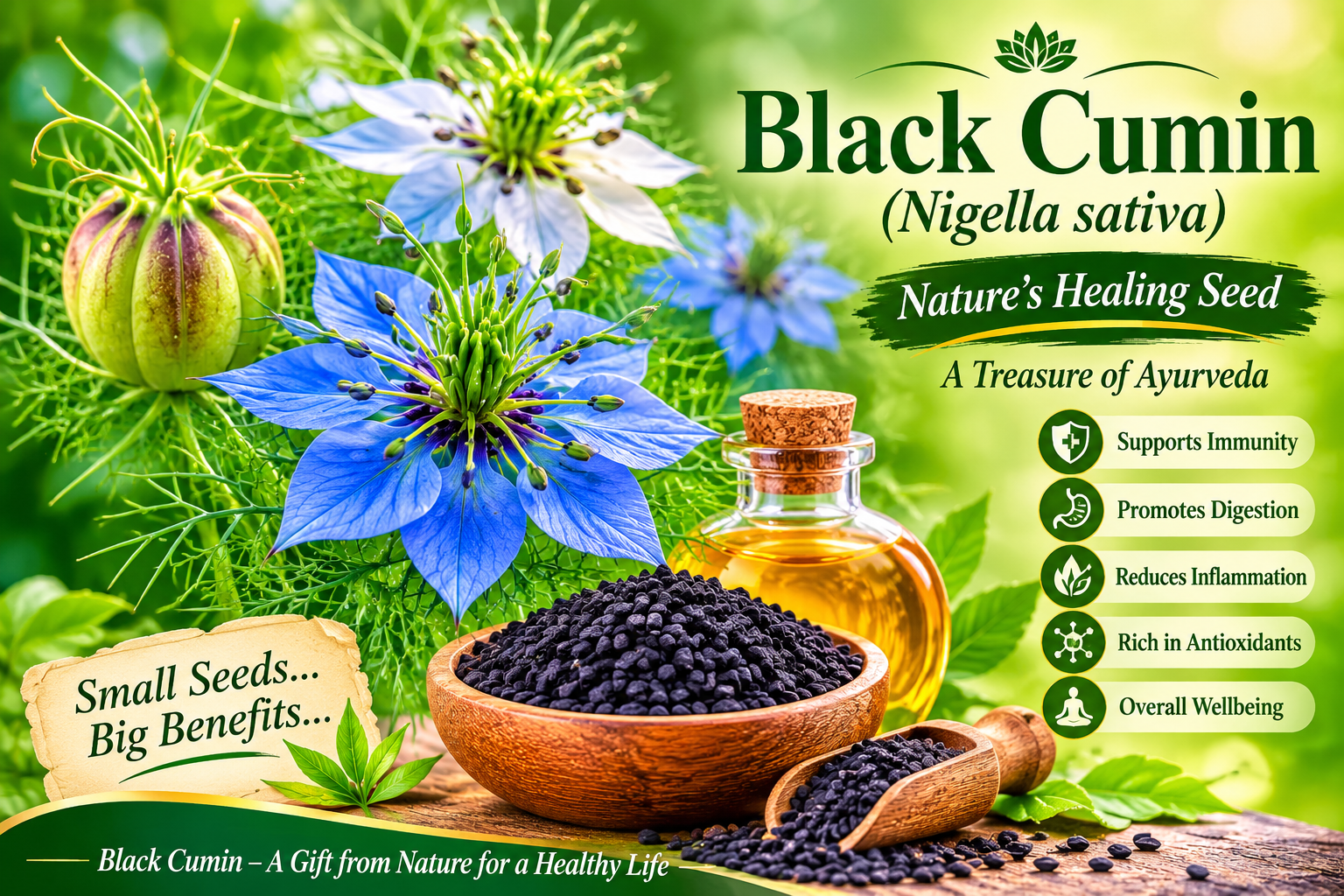
Black Cumin (Nigella sativa)
A traditional medicinal seed with a rich history in Ayurveda and other healing traditions
Black cumin, commonly known as black seed, is the small black seed of Nigella sativa L., a flowering plant belonging to the Ranunculaceae family. Despite its common name, it is botanically different from ordinary cumin (Cuminum cyminum).
For centuries, Nigella sativa has been valued as both a culinary spice and a traditional medicinal plant in South Asia, the Middle East, North Africa and other regions. Today, black cumin is also being investigated scientifically for its antioxidant, anti-inflammatory, metabolic and other biological activities.
What is Black Cumin?
Botanical name: Nigella sativa L.
Family: Ranunculaceae
Common English names: Black cumin, black seed, black caraway
Indian names: Kalonji, Kalaunji
Seed: Small, angular, black seeds with a characteristic pungent aroma and slightly bitter taste.
The accepted botanical name is Nigella sativa L. according to Kew's Plants of the World Online.
The plant is an annual herb producing distinctive flowers followed by capsules containing numerous black seeds.
Black Cumin Is Not Ordinary Cumin
An important point is that black cumin and cumin are not the same plant.
Black cumin Ordinary cumin Nigella sativa Cuminum cyminum Family: Ranunculaceae Family: Apiaceae Commonly called black seed / kalonji Commonly called cumin / jeera Major studied compound: thymoquinone Major characteristic compound: cuminaldehyde
The similarity in common names can cause considerable confusion. Nigella sativa belongs to a completely different botanical family from true cumin.
Historical Use
Black cumin has a long history of culinary and medicinal use across several traditional cultures.
The seeds have been used traditionally in Middle Eastern, South Asian and North African communities. They are commonly used as a spice in breads, vegetables, pulses, pickles and other foods.
Historical records and traditional medical systems describe the use of black seed for digestive complaints, respiratory conditions, skin problems and various inflammatory conditions.
It has also been an important medicinal plant in Unani, Ayurveda and Siddha traditions. Modern scientific literature continues to investigate many of the traditional claims associated with Nigella sativa.
Black Cumin in Ayurveda
In Ayurvedic traditions, Nigella sativa is commonly known by names such as Kalonji and Kalaunji.
Traditional Ayurvedic descriptions associate it particularly with actions related to Vata and Kapha, although terminology and interpretations can vary between classical and later regional sources. A recent review of traditional medicinal literature reports Nigella sativa in Ayurveda in connection with balancing Vata and Kapha.
Its pungent and warming nature makes it particularly interesting from an Ayurvedic perspective.
Traditional Ayurvedic perspective
Black cumin is traditionally considered useful where there is:
Reduced digestive activity
Gas and abdominal discomfort
Kapha-related heaviness
Coldness and sluggishness
Excess mucus
Certain Vata-Kapha digestive patterns
However, individual constitution, digestive strength, season, age and current health condition should always be considered before using medicinal quantities.
Rasa, Guna, Virya and Vipaka
Traditional Ayurvedic interpretation generally describes black cumin as having characteristics associated with:
Rasa (taste): Katu / Tikta — pungent and bitter
Guna (qualities): Laghu and Tikshna — light and penetrating
Virya (potency): Ushna — heating
Dosha influence: Traditionally associated with reducing Vata and Kapha when appropriately used.
Because Ayurvedic descriptions of Nigella sativa can differ between texts and regional traditions, these classifications should be understood as a traditional interpretive framework, rather than as modern laboratory measurements.
What Makes Black Cumin Special?
The seeds contain a complex mixture of:
Fixed oils
Volatile oils
Terpenes
Phenolic compounds
Alkaloids
Saponins
Flavonoids and other phytochemicals
One of the best-studied constituents is thymoquinone (TQ).
Thymoquinone is a major constituent of the volatile oil of Nigella sativa and has received extensive scientific investigation. Other reported compounds include thymohydroquinone, thymol, carvacrol, p-cymene, α-pinene and several other phytochemicals.
Thymoquinone — The Major Research Compound
Thymoquinone has become one of the most extensively studied constituents of black cumin.
Laboratory and animal research has investigated its:
Antioxidant activity
Anti-inflammatory activity
Antimicrobial effects
Effects on glucose metabolism
Effects on lipid metabolism
Potential protective effects on various organs
However, it is important to distinguish laboratory findings from proven clinical treatments. Many interesting effects observed in laboratory and animal studies cannot automatically be translated into treatment recommendations for humans.
Traditional Uses of Black Cumin
Traditionally, black cumin has been used in connection with a wide variety of complaints, including:
Digestive health
Traditionally used for:
Indigestion
Abdominal gas
Bloating
Poor appetite
Digestive sluggishness
Respiratory health
Traditional systems have used black cumin in preparations for:
Cough
Bronchial complaints
Asthma-related symptoms
Excess mucus
Scientific research has investigated these traditional respiratory applications, although evidence varies depending on the preparation and condition studied.
Metabolic health
Research has examined Nigella sativa in relation to:
Blood glucose
Cholesterol
Triglycerides
Blood pressure
Metabolic syndrome
Some human studies have reported potentially beneficial effects, but black cumin should not be considered a replacement for prescribed treatment for diabetes, hypertension or other chronic diseases.
Black Cumin and Inflammation
Inflammation is one of the major areas of modern research into Nigella sativa.
Thymoquinone and other constituents have demonstrated anti-inflammatory activity in experimental research. Researchers have therefore investigated black cumin in conditions involving inflammatory pathways.
Nevertheless, the strength of evidence differs considerably between conditions. More high-quality human clinical research is required before making strong therapeutic claims.
Black Cumin and Antioxidant Activity
Oxidative stress occurs when reactive molecules exceed the body's ability to neutralize them.
Black cumin contains several compounds with antioxidant activity, and laboratory research has demonstrated antioxidant effects from both the seed and its constituents.
This is one reason Nigella sativa has attracted considerable interest in modern phytochemical research.
Black Cumin Oil
Black cumin seeds can be processed to produce black seed oil.
The oil contains both fixed and volatile components and is chemically different from simply consuming the whole seeds.
Black seed oil is traditionally used:
Internally in selected preparations
As a culinary ingredient
Externally for skin and scalp applications
In traditional herbal formulations
The concentration and chemical composition can vary according to:
Cultivar
Growing conditions
Extraction method
Storage
Processing
Product quality
Therefore, one black seed oil product should not automatically be assumed to be equivalent to another.
Black Cumin for Skin and Hair
Traditional use of black cumin oil includes external application to the skin.
Its antioxidant, antimicrobial and anti-inflammatory properties have led to scientific interest in potential dermatological applications.
Traditionally, black seed oil has been used for:
Dry skin
Minor skin irritation
Scalp and hair oiling
Supporting healthy-looking skin
However, concentrated essential oils and undiluted products can irritate sensitive skin. A patch test is sensible before extensive topical use.
Black Cumin and Immunity
Black cumin is sometimes marketed as an “immune booster.”
A more scientifically responsible description is that Nigella sativa has demonstrated immunomodulatory activity in experimental research.
This does not mean that black cumin can prevent or cure infections or replace vaccination, antimicrobial treatment or medical care.
What Does Modern Research Say?
Research on Nigella sativa has expanded considerably over recent decades.
Studies have investigated possible effects involving:
Glucose metabolism
Lipid profile
Blood pressure
Inflammation
Oxidative stress
Respiratory health
Digestive health
Microbial activity
Liver and kidney protection
A comprehensive 2025 review examined phytochemistry, traditional medicinal applications, pharmacological research and safety of Nigella sativa, showing how extensive the modern research field has become.
At the same time, evidence quality is not uniform. Some findings come from laboratory or animal studies, while human clinical studies are often relatively small or use different preparations and doses.
Therefore, black cumin should be viewed as a promising traditional medicinal plant—not as a universal cure.
How Can Black Cumin Be Used?
1. As a culinary spice
The simplest traditional approach is using the seeds as a food spice.
They can be incorporated into:
Bread
Vegetable dishes
Curries
Pulses
Pickles
Spice mixtures
This culinary use is generally different from taking concentrated medicinal extracts.
2. As whole seeds
Traditionally, small quantities of seeds have been used in various herbal preparations.
The appropriate quantity depends on the individual and the intended therapeutic purpose.
3. As oil
Black seed oil is available as a culinary, traditional medicinal or cosmetic preparation.
The concentration and quality should be considered carefully.
4. As a traditional herbal preparation
In Ayurveda and other traditional systems, black cumin may be combined with other herbs according to the individual's condition.
Such combinations should preferably be selected by a qualified Ayurvedic practitioner rather than self-prescribed.
Who Should Be Cautious?
Although black cumin has a long history of traditional use and is generally considered well tolerated, concentrated medicinal preparations require greater care.
Extra caution is appropriate for:
Pregnant women
Breastfeeding women
Children
People taking multiple medicines
People with chronic medical conditions
People taking medicines affecting blood sugar or blood pressure
People with known allergies to herbal products
Black cumin should not be used as a substitute for prescribed medication.
Available clinical and safety literature generally suggests good tolerability, and LiverTox reports no convincing association with clinically apparent liver injury. Nevertheless, this does not mean that every concentrated extract or oil product is risk-free.
Possible Side Effects
When consumed appropriately, black cumin is generally well tolerated.
Some people may experience:
Stomach discomfort
Nausea
Digestive irritation
Allergic reactions
Skin irritation after topical application
Large quantities or concentrated preparations may have different effects from normal culinary use.
Black Cumin and Modern Ayurveda
Ayurveda emphasizes that the medicine should be appropriate for the person, rather than simply choosing a herb because it has many reported benefits.
When considering black cumin, an Ayurvedic practitioner may consider:
Prakriti — individual constitution
Vikriti — current imbalance
Agni — digestive/metabolic capacity
Ama — accumulation associated with impaired digestion and metabolism
Season — environmental influence
Age — individual stage of life
Diet and lifestyle — daily habits
Other medicines — possible interactions
Therefore, the same herb may be appropriate for one person and inappropriate for another.
Black Cumin in Vata, Pitta and Kapha
Vata
Because of its traditionally warming and penetrating nature, black cumin may be useful in selected Vata-Kapha conditions, particularly when coldness and digestive sluggishness are present.
Kapha
Its pungent and warming characteristics may be particularly suitable for selected Kapha-dominant patterns involving heaviness, sluggish digestion and excess mucus.
Pitta
Because black cumin is traditionally considered heating and pungent, excessive use may not be appropriate for Pitta-dominant individuals, particularly when there is marked heat, acidity or inflammatory irritation.
This is one reason Ayurvedic herbal use should be individualized.
Black Cumin vs Black Seed Oil
These terms are often used interchangeably, but they are not exactly the same.
Black cumin seeds: Whole plant material containing fibre, fixed oil, volatile compounds and other constituents.
Black seed oil: A concentrated oil extracted from the seeds.
Black seed essential/volatile oil: A different, much more concentrated fraction containing volatile aromatic compounds.
The method of extraction can substantially influence the chemical composition of the final product.
Quality Matters
When purchasing black cumin or black seed oil, look for:
Correct botanical identification: Nigella sativa
Reliable manufacturer
Proper storage
Batch information
Clear expiry date
Appropriate packaging
No unnecessary additives
For therapeutic use, professional-quality herbal products are preferable to unidentified products with uncertain composition.
A Note About the Famous “Cure-All” Claim
Black seed is sometimes described online as a remedy for every disease except death.
This phrase belongs to traditional religious and historical literature and is an important part of the cultural history surrounding black seed. It should not, however, be presented on a modern health website as scientific proof that black cumin cures every disease.
A responsible approach respects traditional knowledge while clearly distinguishing it from modern clinical evidence.
Black Cumin — The Ayurvedic View in One Table
Aspect Traditional perspective Botanical name Nigella sativa L. Family Ranunculaceae Common name Black cumin / Black seed Indian name Kalonji / Kalaunji Taste Pungent, bitter Nature Light, penetrating Potency Traditionally heating Traditional dosha relationship Mainly Vata-Kapha Important phytochemical Thymoquinone Main traditional focus Digestion, respiratory health, inflammatory conditions and general herbal support Forms Seeds, oil and herbal preparations Modern research Antioxidant, anti-inflammatory, metabolic and other pharmacological effects Important caution Therapeutic use should be individualized
Final Thoughts
Black cumin (Nigella sativa) is much more than an ordinary spice. It is a historically important medicinal seed with a long tradition of use across Ayurveda and other traditional medical systems.
Its unique phytochemistry—particularly the presence of thymoquinone—has made it an important subject of modern scientific research.
The most balanced way to understand black cumin is to bring together traditional Ayurvedic wisdom, botanical identification, phytochemistry and modern clinical evidence.
Black cumin may have an important place in a holistic approach to health, but it should not be promoted as a universal cure. Appropriate selection, dosage, preparation and individual assessment remain essential principles of responsible Ayurvedic practice.
Ayurveda teaches us that the right medicine is not simply the herb with the longest list of benefits—it is the medicine that is appropriate for the individual.
