
By Dr.Thiron Kumarasinghe | Ayurveda
Nelumbo nucifera — A remarkable aquatic plant celebrated for its beauty, symbolism, nourishment and place in traditional medicine.
🪷 “Like a lotus flower that rises unsoiled from muddy water, the awakened mind blossoms untouched by the world's impurities.”
🪷 “No mud, no lotus. Without suffering, there is no understanding; without understanding, there is no peace.”
🪷 “The lotus grows in muddy water, yet blooms above the surface in perfect beauty. So too can the human heart rise above suffering and awaken to wisdom.”
🪷 “Just as the lotus is not stained by the water in which it grows, the wise are not stained by the world in which they live.”
🪷 “Be like the lotus: rooted in the mud, growing through the water, and blossoming toward the light.”
🪷 “The lotus reminds us that even from the darkest mud, the most beautiful flower can bloom.” ✨
🙏 Buddhist Meaning of the Lotus: The lotus symbolizes purity, spiritual awakening, wisdom, and enlightenment because it grows in muddy water yet emerges clean and beautiful above the surface.
Introduction: A Flower Beyond Beauty
Few flowers have captured the human imagination as deeply as the lotus. Rising from the mud beneath still waters, it unfolds its delicate petals above the surface, creating an extraordinary image of beauty emerging from an imperfect environment.
For thousands of years, the lotus has been admired not only as an ornamental aquatic plant but also as a symbol of purity, wisdom, spiritual awakening and renewal. Its influence can be found in religious traditions, ancient art, literature, traditional medicine and Asian culinary heritage.
Known botanically as Nelumbo nucifera, the sacred lotus is particularly important throughout South and East Asia. Its flowers, leaves, seeds and underground rhizomes have been used in different cultural, culinary and medicinal traditions.
Today, scientific researchers continue to investigate its nutritional composition and bioactive compounds, exploring how this ancient plant may contribute to our understanding of natural products and human health. [1,2]
1. Botanical Identity and Natural Characteristics
The sacred lotus belongs to the family Nelumbonaceae. Although it is often mistaken for a water lily, the lotus belongs to a distinct botanical family.
It is a perennial aquatic plant that grows in the muddy beds of ponds, lakes and other shallow freshwater habitats.
Its most recognisable features include:
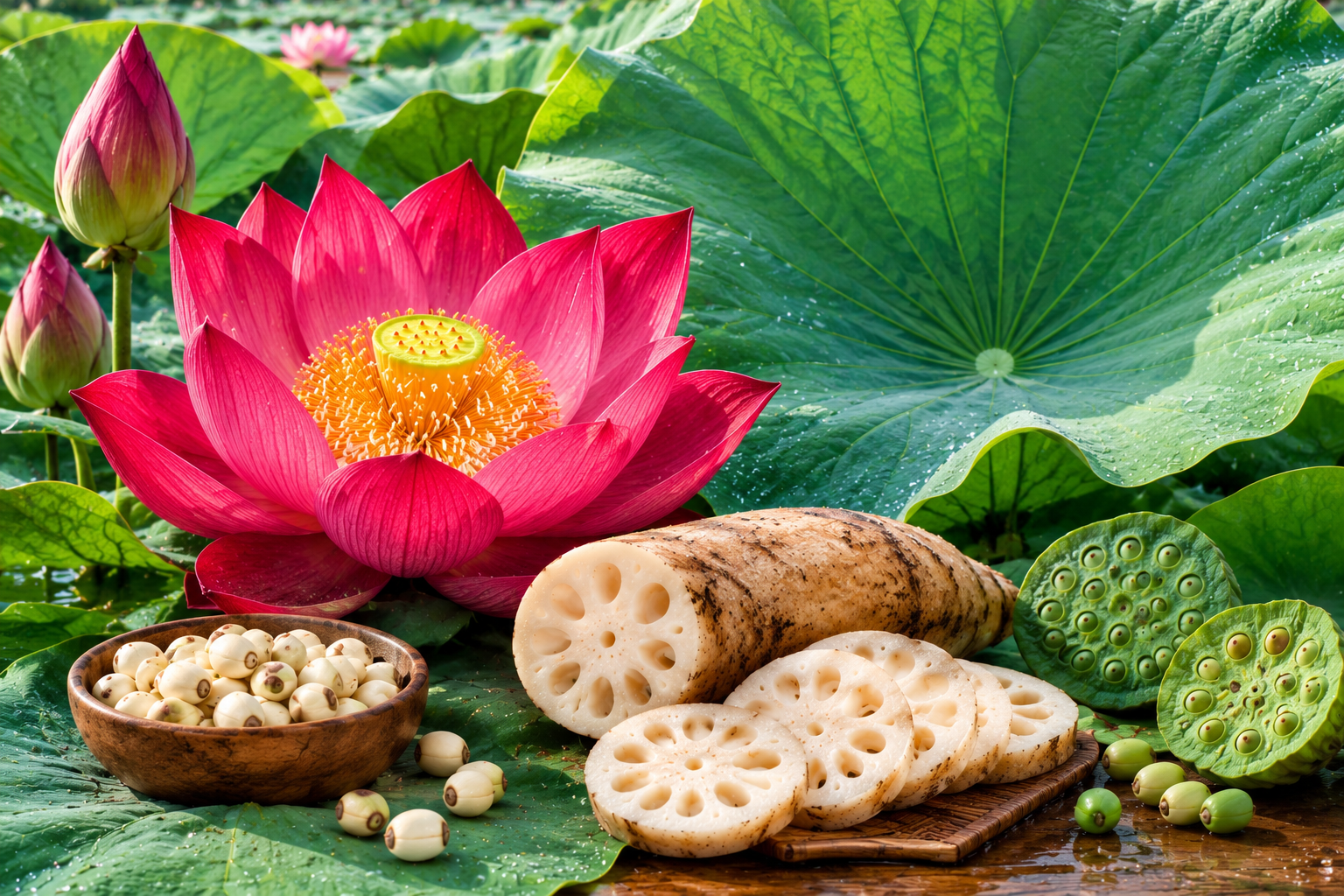
Flowers: Large, elegant flowers, usually pink or white, with numerous delicate petals.
Leaves: Broad, rounded leaves that may rise above the water and repel moisture remarkably well.
Rhizomes: Underground stems that spread through the mud and contain air spaces.
Seeds: Nutritious seeds enclosed within a distinctive, perforated seed head.
Fruits and seed heads: Unusual structures that have become familiar features of botanical art and floral arrangements.
The plant's ability to thrive in muddy environments while producing striking flowers contributes greatly to its symbolic meaning across Asian cultures. [1,2]
2. The Lotus Through History
The lotus has a long history of cultivation and human use across Asia. Archaeological, botanical and literary sources demonstrate its importance as a food plant, ornamental species and religious symbol.
In South Asian traditions, the lotus appears in ancient religious literature, sculpture, temple decoration and artistic representations of deities. In Buddhist traditions, it became an especially powerful image of spiritual development and liberation.
In China and other parts of East Asia, the lotus developed a rich place in philosophy, poetry, painting, gardening and traditional herbal practice. Its beauty and association with moral integrity made it an enduring subject of artistic expression.
The lotus also has a history in ancient Egyptian symbolism. However, the Egyptian water lilies commonly associated with ancient Egyptian art belong to the genus Nymphaea, not the Asian sacred lotus, Nelumbo nucifera. These plants should not be confused botanically. [1,2]
Across different periods and societies, the lotus has continued to connect the natural world with ideas of life, beauty, spiritual development and renewal.
3. Cultural and Spiritual Significance
The lotus in Buddhism
In Buddhism, the lotus is a widely recognised symbol of purity, wisdom and spiritual awakening.
Its growth offers a meaningful metaphor: although its roots develop in mud, its flower rises above the water and opens toward the light. This is often interpreted as a reminder that human beings can cultivate wisdom and compassion despite the difficulties of worldly life.
Lotus flowers and lotus-shaped pedestals are prominent in Buddhist statues, temple paintings and sacred architecture throughout Asia, including Sri Lanka.
The lotus is therefore more than a decorative motif. It expresses the possibility of inner transformation, mindfulness and freedom from attachment.
The lotus in Hinduism
In Hindu traditions, the lotus is associated with divine beauty, fertility, prosperity and spiritual purity.
Gods and goddesses are frequently represented standing or seated upon lotus flowers. The flower is particularly associated with Lakshmi, the goddess of prosperity, abundance and good fortune, and is also important in the iconography of other deities.
The lotus also appears in Hindu philosophical imagery, where it can represent the unfolding of consciousness and the relationship between spiritual life and the material world.
The lotus in art and architecture
The lotus has inspired generations of artists, architects, poets and craftspeople.
Its symmetrical petals, rounded leaves and distinctive seed head appear in temple carvings, paintings, textiles, jewellery and architectural ornamentation. Lotus motifs are found throughout South and East Asia, reflecting the plant's widespread cultural influence.
The flower's enduring appeal lies in its ability to communicate complex ideas through a simple natural form.
The lotus in Sri Lankan culture
In Sri Lanka, the lotus holds a particularly meaningful place in Buddhist religious life. Lotus flowers are commonly offered at Buddhist temples as expressions of devotion, respect and reverence.
Their presence in religious ceremonies and temple settings reflects values such as purity of intention, mindfulness and the cultivation of wisdom.
The lotus is also familiar in Sri Lankan visual culture, where its graceful form appears in traditional designs and decorative arts.
Beyond its religious associations, the lotus offers a powerful reminder of the close relationship between nature, cultural heritage and spiritual practice.
4. The Lotus in Traditional Medicine
Different parts of Nelumbo nucifera have been used in traditional Asian medical systems, including Ayurveda and traditional Chinese medicine.
Traditional practices have employed the flowers, leaves, seeds, seed embryos and rhizomes in different preparations. The specific part used, its preparation and its traditional purpose vary according to the medical system and regional tradition.
It is important to distinguish these historical uses from modern clinical evidence. Traditional use can guide scientific investigation, but it does not automatically establish that a preparation is effective or safe for treating a particular disease.
Lotus flowers
Lotus flowers have a long history of cultural and medicinal use. In some traditional systems, flower preparations have been used in practices associated with calming, cooling and supporting general well-being.
Modern laboratory research has investigated flavonoids and other plant constituents found in lotus flowers. However, evidence from laboratory studies does not by itself establish that lotus flower preparations provide a particular therapeutic benefit in humans.
Lotus leaves
Lotus leaves have been used in traditional herbal preparations and are also valued for their distinctive botanical properties.
Researchers have studied leaf extracts for their chemical constituents and possible biological activities, including antioxidant and metabolic effects.
Some findings are promising at the experimental level, but more high-quality human studies are needed before specific medical benefits can be confidently recommended.
Lotus seeds
Lotus seeds are both a traditional food and an ingredient in several Asian herbal traditions.
They provide nutrients and contain various phytochemicals, including flavonoids and alkaloids. In traditional Chinese medicine, lotus seeds have been used in preparations associated with nourishing and calming functions.
As a food, properly prepared lotus seeds can contribute to a varied diet. Their use as a concentrated medicinal product, however, should be considered separately because the dose, composition and potential interactions may differ.
Lotus seed embryo
The small green embryo inside the lotus seed is known in traditional Chinese medicine as Lian Zi Xin.
It has a distinct history of traditional use, particularly in preparations described as clearing heat and calming the mind. It also contains bioactive alkaloids that have attracted scientific interest.
These traditional descriptions belong to a particular medical framework and should not be interpreted as proof that the embryo treats anxiety, insomnia, cardiovascular disease or other clinical conditions.
Lotus rhizomes
The underground rhizomes are widely eaten in Asian cuisines. Depending on the region, they may be boiled, steamed, stir-fried, pickled or incorporated into soups.
They contain dietary fibre and other nutrients, making them a useful food ingredient.
Traditional medical systems have also used rhizome preparations for various digestive and other complaints. Contemporary research has examined their antioxidant and anti-inflammatory potential, but further clinical investigation is needed to establish reliable therapeutic applications. [2,3]
5. What Does Modern Science Tell Us?
Scientific interest in the sacred lotus has expanded considerably. Researchers have identified numerous compounds across its different plant parts, including flavonoids, phenolic compounds and alkaloids.
These constituents are being studied for several biological activities.
Antioxidant activity: Certain lotus extracts demonstrate antioxidant activity in laboratory experiments. This provides a basis for further research, but it does not prove that eating lotus or taking lotus supplements prevents disease.
Anti-inflammatory potential: Experimental studies have investigated whether particular lotus compounds influence inflammatory pathways. Their relevance to human inflammatory disorders remains to be established through appropriate clinical trials.
Metabolic research: Some preclinical studies have explored the possible effects of lotus constituents on glucose and lipid metabolism. Such findings should not be interpreted as evidence that lotus can replace established treatment for diabetes or cardiovascular disease.
Nutritional value: Lotus seeds and rhizomes offer practical dietary value as food ingredients. This is a more established use than many of the therapeutic claims associated with concentrated extracts.
A comprehensive scientific review published in 2024 discussed the lotus's cultural, nutritional, ecological and medicinal significance, while highlighting the breadth of research still required to understand its potential fully. [2]
The most balanced conclusion is that the sacred lotus is a nutritionally useful and chemically interesting plant with a long history of traditional use. Its possible therapeutic applications deserve further research, but many specific health claims remain unconfirmed in humans.
6. The Lotus and the Science of Self-Cleaning Surfaces
One of the most fascinating features of the lotus is its ability to remain relatively clean despite growing in muddy water.
Lotus leaves have microscopic surface structures and a waxy coating that make them highly water-repellent. Water droplets tend to bead up and roll away, carrying some dirt particles with them.
This phenomenon is commonly known as the lotus effect.
Scientists and engineers have studied this natural mechanism to develop water-repellent and self-cleaning surfaces for potential use in coatings, materials and other technologies.
The lotus therefore offers inspiration not only to medicine and culture but also to biomimicry—the practice of learning from nature to solve human problems. [1,2]
7. Food, Nutrition and Everyday Use
The sacred lotus is a versatile plant with culinary traditions extending across many Asian countries.
Its rhizomes are used in soups, vegetable dishes and stir-fries. Lotus seeds are consumed cooked or incorporated into desserts, while lotus leaves are sometimes used to wrap food or prepare traditional dishes. Lotus flowers and leaves are also used in certain teas and culinary preparations.
These uses demonstrate that the lotus has practical value beyond its ornamental beauty.
For everyday consumption, food-grade lotus products prepared hygienically are preferable to unverified wild-harvested plants or concentrated extracts of uncertain composition.
People considering medicinal preparations should also be aware that the safety of a product depends on the plant part, preparation method, dose, purity and individual circumstances.
8. Responsible Use and Safety
Although the lotus has a long history of traditional use, natural origin alone does not guarantee safety.
A few precautions are important:
Choose correctly identified, food-grade plant material from a reliable source.
Do not assume that all lotus species or all plant parts have the same effects.
Consult a qualified healthcare professional before using concentrated extracts or medicinal preparations, especially if taking regular medication.
Seek professional advice during pregnancy or breastfeeding, when evidence about the safety of medicinal preparations may be limited.
Do not discontinue prescribed medication in favour of lotus products.
Remember that traditional uses and promising laboratory results do not replace clinical evidence.
These precautions allow traditional botanical knowledge to be explored respectfully and responsibly.
9. A Timeless Lesson from the Lotus
The sacred lotus has remained meaningful across generations because it unites beauty, resilience, nourishment and spiritual symbolism in a single plant.
Its flower inspires reflection. Its seeds and rhizomes have nourished communities. Its role in traditional medicine has encouraged generations of practitioners to observe and study the natural world. Its leaf structure continues to inspire scientific innovation.
For Ayurveda and other traditional healing systems, the lotus offers an opportunity to appreciate botanical heritage while maintaining a thoughtful relationship with modern research.
Its deeper message is universal: the conditions in which life begins do not necessarily determine the beauty or potential of what it becomes.
The lotus continues to remind us that nature is not merely something to admire. It is a source of cultural meaning, practical knowledge and questions that science is still working to answer.
References and Further Reading
Royal Botanic Gardens, Kew. Sacred lotus — Nelumbo nucifera. Botanical characteristics, cultural significance and uses.
Yang H, He S, Feng Q, et al. “Lotus (Nelumbo nucifera): a multidisciplinary review of its cultural, ecological, and nutraceutical significance.” Bioresources and Bioprocessing. 2024;11:18. doi:10.1186/s40643-024-00734-y.
Chen G, Zhu M, Guo M. “Research advances in traditional and modern use of Nelumbo nucifera: phytochemicals, health promoting activities and beyond.” Critical Reviews in Food Science and Nutrition. Published online 2019. doi:10.1080/10408398.2018.1553846.
Medical Disclaimer
This article is provided for educational and informational purposes. It discusses cultural traditions, historical uses and scientific research relating to the lotus. It is not intended to diagnose, treat, cure or prevent any disease, and it does not replace individual medical advice. The therapeutic effects and safety of specific lotus preparations may vary, and many proposed benefits require further clinical research.
