
By Dr. Thiron Kumarasinghe | Ayurveda
Discover the Sanskrit meaning, botanical identity, traditional Ayurvedic properties and historical significance of Shatavari, an important herb in Ayurvedic herbal practice.
1. Introduction to Shatavari
Shatavari, known in Sanskrit as शतावरी (Śatāvarī), is a well-known medicinal herb in the traditional Ayurvedic system of medicine.
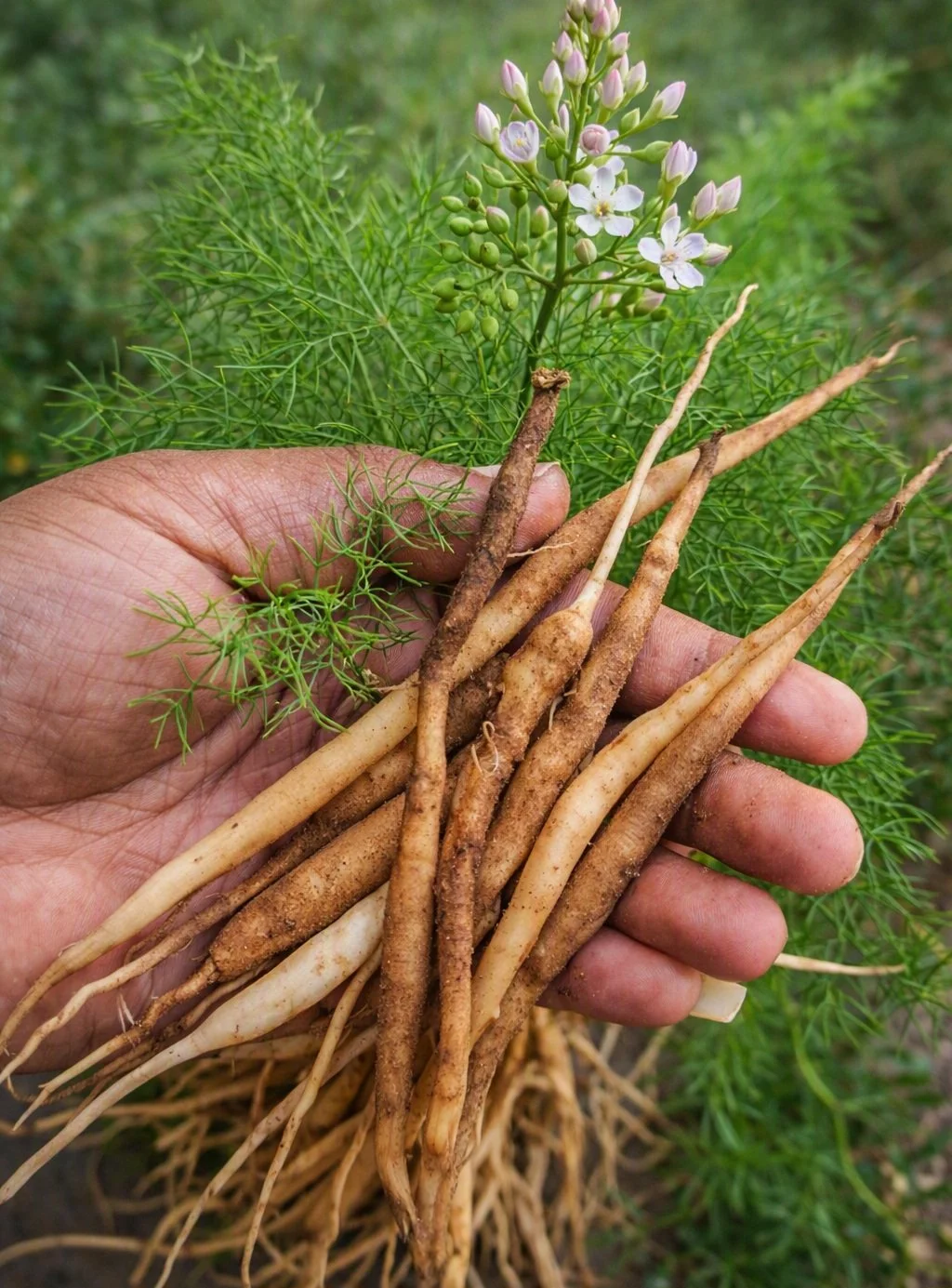
Its botanical name is Asparagus racemosus Willd., and it belongs to the family Asparagaceae. The fleshy, tuberous roots are the principal part traditionally used in Ayurvedic preparations.
For centuries, Shatavari has held an important place in Ayurvedic herbal knowledge, particularly in discussions of nourishment, vitality, reproductive wellness and rejuvenation.
Today, this traditional herb continues to attract interest among people exploring Ayurveda and natural approaches to wellbeing.
2. What Does the Sanskrit Name Shatavari Mean?
The Sanskrit name Śatāvarī (शतावरी) is traditionally associated with the word Śata (शत), meaning “one hundred.”
The name is often linked to the plant's numerous fleshy roots. Some traditional and modern interpretations also associate Shatavari with reproductive vitality and its historical role in women's health.
The expression “the one who possesses a hundred husbands” is sometimes used as a popular interpretation of the name. However, this should be understood as a traditional interpretation rather than a definitive literal translation.
For an Ayurvedic understanding, the more important point is Shatavari's long-standing place as a nourishing and rejuvenating herb.
3. Botanical Identity and Characteristics
Botanical name: Asparagus racemosus Willd.
Sanskrit name: शतावरी (Śatāvarī)
Family: Asparagaceae
Common English name: Wild asparagus
Part traditionally used: Tuberous root
Shatavari is a climbing plant found across parts of South Asia, including India and Sri Lanka. Its characteristic clusters of fleshy roots distinguish it from many other plants.
Correct botanical identification is essential because different species may have different properties and uses. Shatavari should not be confused with the commonly eaten vegetable asparagus, Asparagus officinalis, which is a different species.
4. Shatavari in Traditional Ayurveda
In Ayurveda, medicinal plants are understood through their traditional qualities and their relationship with an individual's constitution and present condition.
Shatavari is commonly described in Ayurvedic materia medica using the following properties:
Rasa (रस) – Taste: Madhura (sweet) and Tikta (bitter).
Guna (गुण) – Qualities: Guru (heavy) and Snigdha (unctuous).
Virya (वीर्य) – Potency: Śīta (cooling).
Vipāka (विपाक) – Post-digestive effect: Madhura (sweet).
These are traditional Ayurvedic descriptions. Different classical references and preparations may vary in how they describe or apply an herb's properties.
Shatavari is traditionally regarded as particularly relevant when nourishment, cooling qualities and support for Vata and Pitta balance are desired. Its suitability should nevertheless be considered individually, including where Kapha-related characteristics or digestive heaviness are present.
5. Shatavari as a Rasayana (रसायन)
One of the important concepts in Ayurveda is Rasayana (रसायन).
Rasayana refers to a traditional approach concerned with nourishment, rejuvenation, vitality and the maintenance of healthy function.
Shatavari is traditionally classified among the nourishing herbs used in this context. Its place in Ayurvedic practice reflects the broader principle that health involves more than addressing individual symptoms: it also involves appropriate nourishment, daily habits and attention to the individual's condition.
Rasayana is a traditional Ayurvedic concept and should not be interpreted as a guarantee of longer life or protection against disease.
6. Traditional Uses of Shatavari
Shatavari has several traditional applications in Ayurvedic practice.
Women's wellness
Shatavari is particularly well known for its traditional association with women's reproductive health and nourishment.
Its historical use has contributed to its continuing popularity in Ayurvedic preparations intended for women's wellbeing. However, traditional use does not establish that every preparation will be effective for every person or condition.
Traditional use during breastfeeding
Shatavari has traditionally been used in Ayurvedic preparations intended to support lactation.
Breast-milk production and breastfeeding difficulties have many possible causes. Anyone experiencing these difficulties should receive appropriate professional support rather than relying on an herbal product alone.
Nourishment and vitality
Shatavari is traditionally described as a nourishing herb. In Ayurvedic practice, it may be considered as part of a broader approach to maintaining strength and wellbeing when appropriate to the individual.
Reproductive wellness in men
Although Shatavari is widely associated with women's health, traditional Ayurvedic applications are not restricted exclusively to women.
Its nourishing and Rasayana qualities have also contributed to its traditional use in preparations intended to support male reproductive vitality. This should not be interpreted as proof that Shatavari improves fertility or treats sexual or reproductive disorders.
Digestive and internal nourishment
Shatavari's traditionally described cooling and unctuous qualities have also influenced its use in selected Ayurvedic preparations concerned with internal nourishment and soothing support.
Its suitability depends on the person's digestive function, constitution, current symptoms and overall health.
7. Shatavari and Modern Scientific Research
Modern research has investigated Asparagus racemosus, including its chemical constituents and possible biological activities.
The roots contain compounds including steroidal saponins, commonly discussed in the scientific literature under the name shatavarins.
However, laboratory findings, traditional experience and clinical studies in humans provide different levels of evidence. Findings from one type of preparation cannot automatically be applied to every Shatavari powder, extract, tablet or capsule.
More high-quality human research is needed to establish the effectiveness and safety of particular preparations for specific health conditions.
For this reason, Shatavari should not be described as a proven cure for infertility, hormonal disorders, menopause, cancer or other diseases.
A responsible approach respects traditional Ayurvedic knowledge while recognising the importance of scientific evidence and appropriate medical care.
8. How Is Shatavari Prepared?
In traditional and contemporary herbal practice, Shatavari may be prepared in several forms, including:
Churna (चूर्ण) – herbal powder.
Traditional decoctions and compound formulations.
Extracts.
Tablets and capsules.
These preparations are not necessarily equivalent. The botanical material, processing method, concentration, ingredients and quality controls can differ considerably.
The appropriate form and amount depend on the particular preparation and the individual using it. A dosage should not be assumed from the botanical name alone.
9. Responsible Use and Precautions
Natural origin does not automatically mean that a product is suitable for everyone.
Before using a concentrated Shatavari preparation, consider the following precautions:
Seek professional advice during pregnancy or breastfeeding.
Discuss use with a qualified healthcare professional if you take prescription medicines or have an existing medical condition.
Do not use Shatavari as a substitute for necessary diagnosis or medical treatment.
Check the product's ingredients, quality information, directions and applicable regulatory status.
Stop using the product and seek appropriate medical advice if an adverse reaction occurs.
People with known allergies to the ingredients should avoid the relevant product. Individual assessment is particularly important when considering herbal preparations for long-term use.
10. Shatavari Capsules
Shatavari is also available in capsule form, providing a convenient way to take a herbal preparation.
When considering any Shatavari capsule, it is important to establish exactly what it contains. A capsule may contain root powder or a concentrated extract, and these are not interchangeable without appropriate information.
A responsible product description should clearly state:
Botanical identity and plant part used.
Full ingredients and capsule strength.
Directions for use supported by the product's approved information.
Manufacturer or responsible supplier details.
Batch, expiry and storage information.
Applicable product registration and labelling details.
Any Shatavari capsules presented on this website should be described according to their actual formulation and verified regulatory status. No therapeutic benefit, dosage or safety claim should be assumed without appropriate support.
11. An Ayurvedic Perspective from Dr. Thiron Kumarasinghe
As an Ayurvedic physician, I believe that understanding a medicinal herb requires more than knowing its popular uses.
Ayurveda considers the individual, including Prakriti (constitution), Vikriti (current imbalance), Agni (digestive and metabolic function), age, diet, lifestyle and overall health.
An herb that is appropriate for one individual may not be suitable for another. Responsible herbal practice therefore requires appropriate assessment, careful selection and attention to the quality of the preparation.
Shatavari provides an interesting example of the depth of traditional Ayurvedic herbal knowledge. Its Sanskrit name, botanical characteristics and historical role as a Rasayana all contribute to its continuing significance.
My approach is to respect this traditional knowledge while communicating its uses honestly, recognising the limits of available evidence and placing individual wellbeing first.
Conclusion: Shatavari — A Valuable Part of Ayurvedic Herbal Heritage
Śatāvarī (शतावरी) is an important herb in the Ayurvedic tradition, known botanically as Asparagus racemosus Willd.
Its traditional significance includes nourishment, vitality, reproductive wellness and its classification as a Rasayana herb.
Understanding Shatavari responsibly means appreciating its traditional role without exaggerating what modern science has established. Botanical accuracy, product quality, individual suitability and professional guidance remain essential.
Ayurveda is not simply about choosing a popular herb. It is about understanding the individual and choosing an appropriate approach with knowledge, care and responsibility.
Dr. Thiron Kumarasinghe
Ayurveda | Sri Lanka
Educational Disclaimer
This article is provided for general educational information about traditional Ayurvedic knowledge. It is not a substitute for individual medical advice, diagnosis or treatment. Traditional uses described here should not be interpreted as guarantees of clinical effectiveness. Product availability, use and claims must comply with applicable Sri Lankan laws and professional requirements.
